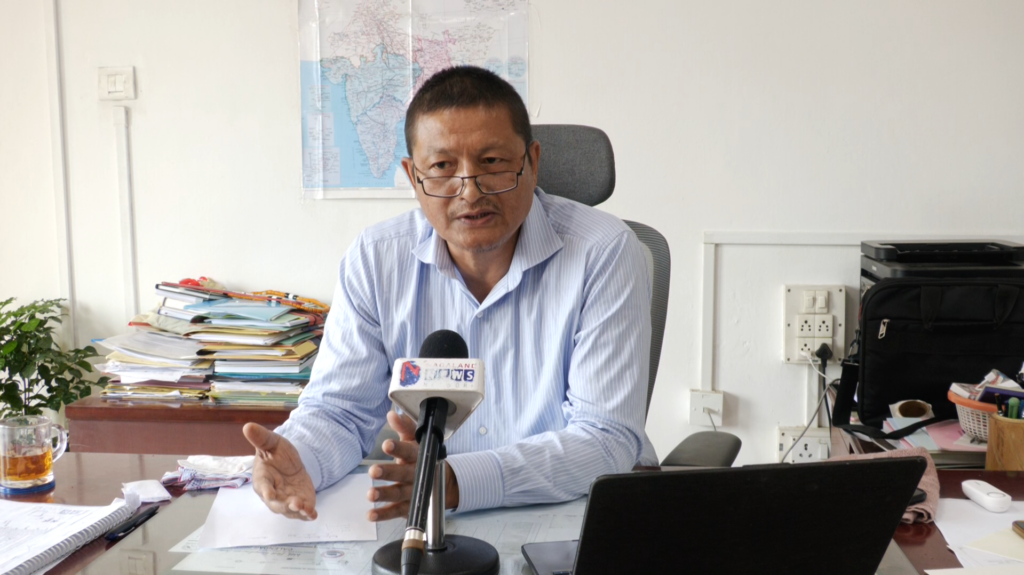
Kohima, September 17: Nagaland Power Department Chief Engineer (Distribution and Revenue) R. Lobosang Jamir has attributed the recent complaints over unusually high electricity bills to the shift towards accurate consumption recording through smart meters, saying many consumers had previously been receiving average or minimum bills.
Jamir said the department spends nearly ₹600 crore annually on power purchase, while electricity revenue collection is around ₹300 crore, resulting in a substantial gap.
According to him, a large number of consumers were earlier billed based on average consumption because of a shortage of meter readers. He said the department has around 3.5 lakh registered consumers but only about 300 meter readers, making regular physical meter reading difficult.
“With the installation of smart meters, the actual consumption is being recorded,” Jamir said, adding that bills are therefore reflecting the electricity actually consumed rather than an estimated average.
The department has so far installed nearly 50,000 smart meters, mainly in Dimapur, Chümoukedima and Kohima.
Jamir clarified that consumers with smart meters are not required to manually submit meter readings. The meters transmit readings automatically through SIM-based communication, with readings collected at the end of each month and bills generated subsequently.
For consumers who believe a bill is abnormally high, Jamir advised them to approach their respective Sub-Divisional Officer (SDO) for verification. If a meter is found to be defective or the billing error is established to be on the department’s side, the bill can be rectified and the meter replaced.
He also said consumers facing difficulty in paying a genuine accumulated bill can request payment in up to three instalments.
On complaints about smart meters, Jamir said the department does not plan to return to the old system of regular physical meter reading, noting that smart metering is part of the government’s wider power-sector reforms.
He further highlighted rooftop solar as an option for domestic consumers seeking to reduce electricity costs. According to Jamir, subsidies are available for installations up to 3 kW, with support from both the Centre and the state government.
Jamir said the department has empanelled 26 vendors for rooftop solar installations and that consumers can choose a vendor of their preference.
Appealing to consumers, he said the department would verify complaints where bills appear abnormally high, but consumers would have to pay if the recorded consumption is found to be accurate.
He also linked improved metering and revenue collection to the state’s ability to access infrastructure support under schemes such as the Revamped Distribution Sector Scheme (RDSS).
Jamir acknowledged that there has been resistance to smart-meter installation but said the department is conducting sensitisation programmes across colonies and towns to encourage consumers to accept the system and facilitate improvements to Nagaland’s electricity infrastructure.