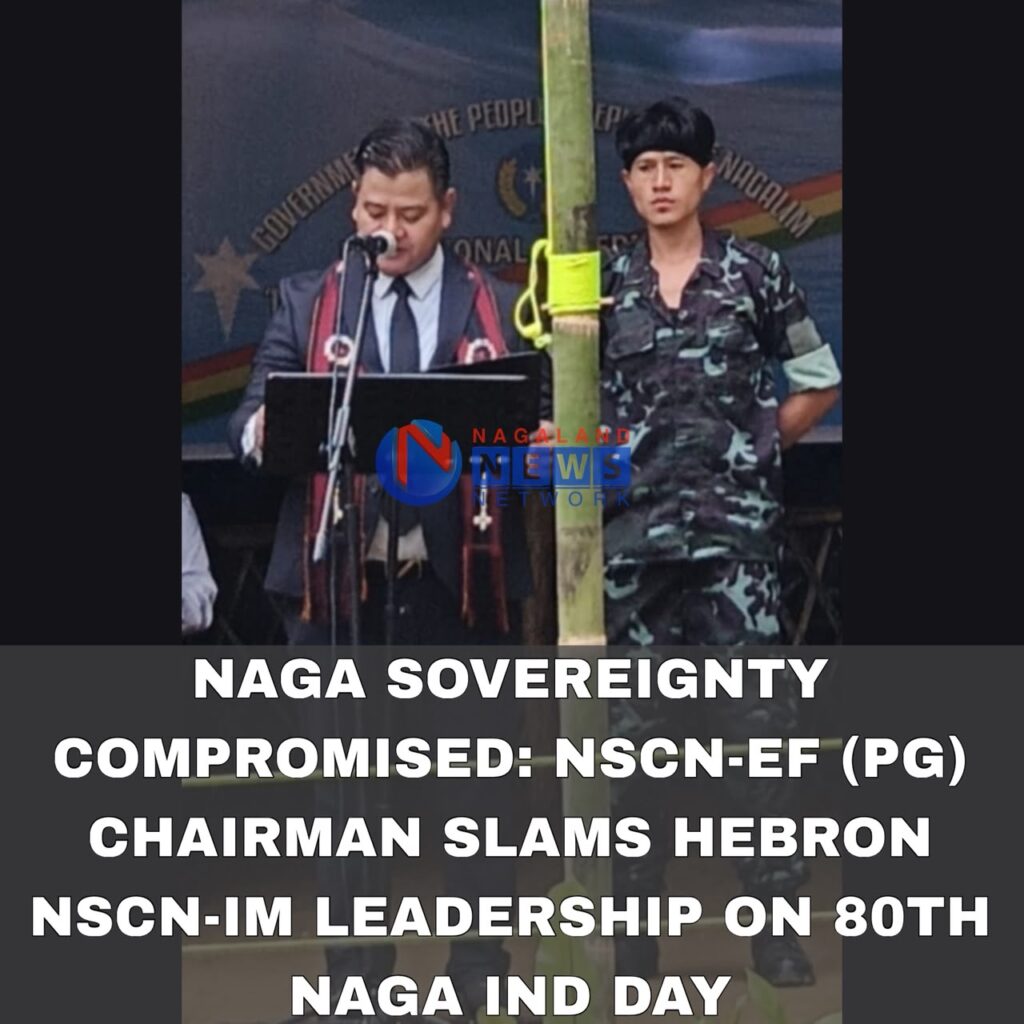
The NSCN-EF (PG) Chairman, in his message on the 80th Naga Independence Day, called for greater unity among the Naga people while strongly reaffirming the Naga people’s political rights, historical declaration of independence and aspiration for a sovereign political future.
Reflecting on the Naga political journey, he referred to key milestones including the 1929 memorandum of the Naga Club, the declaration of Naga independence on August 14, 1947, and the 1951 Naga Plebiscite. He said these historical events represent the political foundation inherited from the Naga forefathers and should not be overlooked in the present political process.
He also referred to the 16-Point Agreement of 1960 and the Shillong Accord of 1975, describing them as experiences from which the Naga people must learn. He stressed that past political developments should not lead to further division among the Nagas.
A major portion of his address focused on the Leadership of Hebron, NSCN, particularly over the competencies submitted to the Government of India. The Chairman criticised what he described as compromises on the Naga political position, maintaining that the Naga people’s political rights and sovereignty cannot be surrendered or transferred without the mandate of the people.
He further referred to the joint meeting of Civil National Workers and Naga Army Officers held at Mt. Horeb Camp on July 21, 2026, stating that the meeting rejected the competencies submitted to the Government of India and subsequently declared the establishment of a Provisional Government until a full-fledged government is formed.
The Chairman maintained that the people remain the source of political authority and called on Naga national workers and the Naga people across the homeland and diaspora to stand united. He also acknowledged the people of Eastern Nagalim for their continued stand on the Naga political issue.
Calling for an end to divisions based on personalities, organisations and tribal affiliations, he urged the Nagas to place the larger national interest above individual or organisational interests.
He concluded by appealing for unity, courage, truth and faith, stressing that the Naga political aspirations must be preserved for present and future generations.