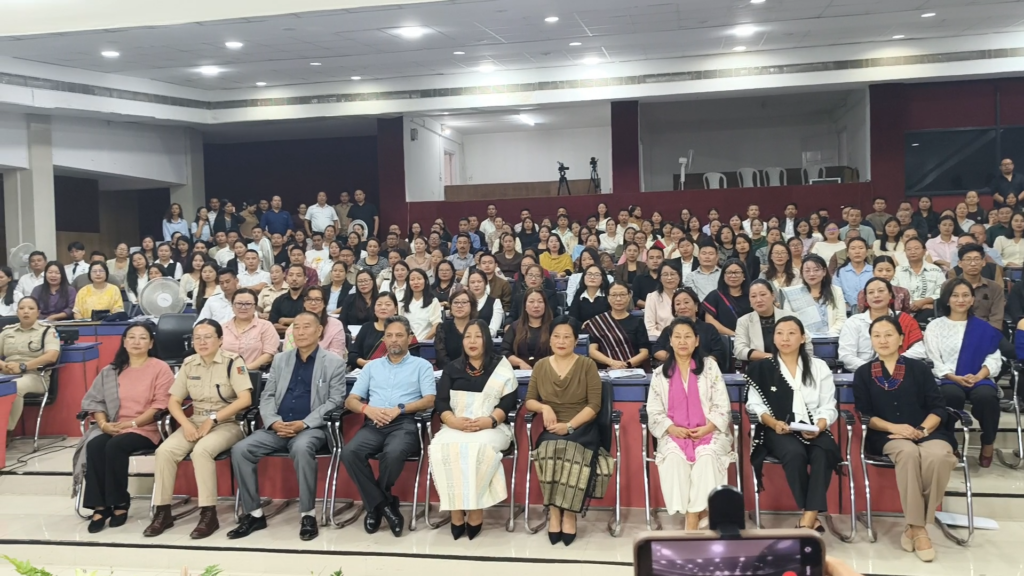
Kohima, August 25: Director General of Police (DGP) Rupin Sharma has called for stronger coordination among the police, government agencies, legal services, civil society and the public to effectively address violence against women and children in Nagaland.Addressing the State Level Convergence Meeting to Address Violence Against Women and Children at the Capital Convention Centre, Kohima, on Tuesday, DGP Sharma spoke on the Role of Police in Implementing Women and Child Protection Services.
The meeting was organised by Mission Vatsalya and Mission Shakti under the Department of Social Welfare, Government of Nagaland, in collaboration with the Nagaland Police and Nagaland State Legal Services Authority.Highlighting the gap between policy and implementation, Sharma said that while numerous laws, schemes and institutional mechanisms exist, their impact on the ground remains limited unless they are supported by effective coordination, capable personnel and committed implementation.He said the public often approaches the police for a wide range of problems, including domestic violence, child abuse, family disputes, fraud and other social issues.
While the police cannot intervene in every civil dispute, he stressed that the force must have the necessary legal and institutional capacity to respond effectively wherever public safety or criminality is involved.Sharma also highlighted social issues such as illegal money lending and alcohol abuse, noting their damaging impact on families and communities. He pointed out that public expectations of the police can sometimes exceed the powers provided under existing laws, underlining the need to strengthen systems within the framework of law.
On child protection, the DGP said social norms and legal understanding continue to evolve, with certain practices previously regarded as acceptable increasingly being recognised as child abuse, domestic violence or other forms of wrongdoing.He emphasised the importance of creating accessible institutions where victims can report abuse and seek assistance. Women, children and other victims, he said, must be encouraged to speak up, as early reporting can help authorities understand the scale of problems, allocate resources and identify patterns that could prevent more serious offences.
A key announcement at the meeting was the proposed launch of a single online police complaint and reporting portal, expected within the next 10 to 12 days. The system is intended to allow citizens to submit complaints electronically and receive a tracking number to monitor the progress of their cases.Clarifying the proposed system, Sharma said a complaint would not automatically constitute an FIR. Police would examine whether the matter involves a cognisable offence, a non-cognisable offence or is purely civil in nature. Where a cognisable offence is disclosed, an FIR would have to be registered, while purely civil matters would be directed to the appropriate forum.The system is also expected to strengthen supervisory monitoring, enabling senior police officers to track the progress of complaints and preliminary enquiries from the police station level up to the DGP’s office. Complainants would also be able to know what action has been taken and, where applicable, why an FIR was not registered.Sharma said early reporting of incidents such as stalking, harassment and child abuse could help police identify recurring patterns and potentially prevent escalation into more serious crimes.He further cautioned village councils, customary institutions, associations and individuals against taking the law into their own hands, particularly in cases involving serious cognisable offences that fall under the formal criminal justice system.The DGP also stressed the importance of public servants fulfilling the responsibilities attached to their positions, saying that institutions can only earn public trust when officials actively perform the duties for which they are entrusted with public resources.
He called for NGOs, civil society organisations and the public to play a constructive role in addressing social problems while ensuring that their interventions remain within the law.The meeting ultimately underscored the need for greater institutional coordination, accessible reporting mechanisms and stronger public confidence in government and justice institutions to improve protection and response mechanisms for women and children in Nagaland.